Almost every chatbot you use writes its answer one token at a time, left to right, with each new piece depending on everything before it. On October 19, Inception released Mercury 3, which it calls the most capable diffusion-based large language model released to date, and which works differently: it refines a whole block of text at once. The company says the model runs at 1,068 tokens per second on Nvidia GPUs, four to eight times faster than the small models it compares against. This explainer covers how the two approaches differ, why speed is the headline, and which claims still need independent checking.
How standard language models generate text
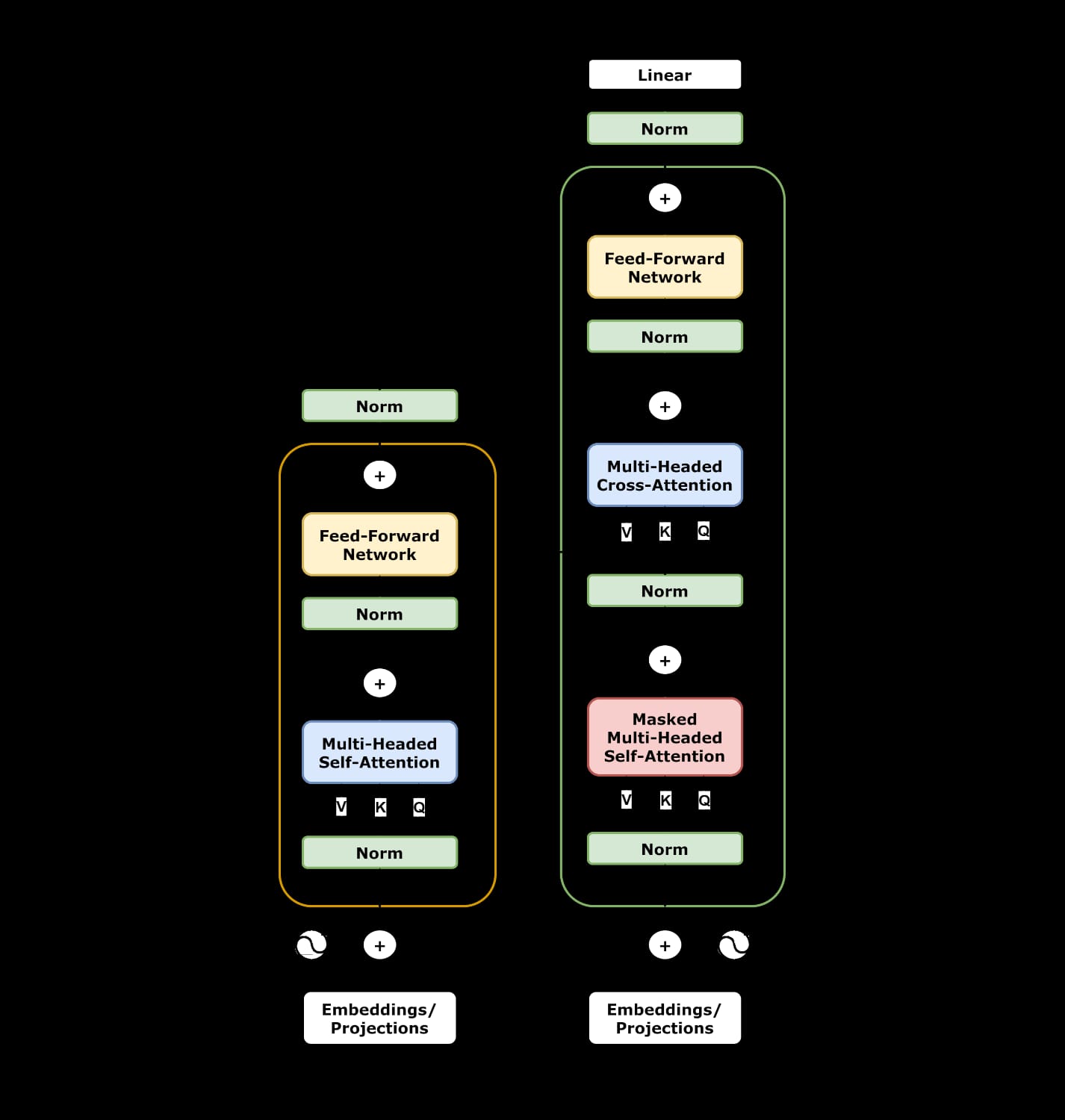
Most large language models are autoregressive. Given a prompt, the model computes a probability for every possible next token, picks one, appends it, and repeats. The architecture most of them use, the transformer introduced in “Attention Is All You Need,” is very good at this, and training is efficient because the model can learn to predict every position in a document in parallel.
Generation is the problem. Each new token needs a full pass through the network, and token number 200 cannot be computed until token 199 exists. The hardware spends much of its time waiting on memory rather than doing arithmetic, which is why serving systems add tricks such as caching and batching. Our guide to how LLM inference serving works describes those tricks in detail. They make autoregressive models faster, but the one-token-at-a-time structure remains.
How diffusion changes the process
Diffusion models first became famous for images. A training process gradually corrupts real images with noise, and a network learns to reverse that corruption. At generation time, the model starts from noise and removes it over several steps until a coherent picture emerges. Our explainer on how diffusion models generate images walks through that idea, which traces back to work such as the “Denoising Diffusion Probabilistic Models” paper.
Text is made of discrete tokens, not continuous pixels, so text diffusion adapts the idea. A common formulation starts with a sequence of masked or noisy placeholders and has the network predict many positions at once, then revises its guesses over a small number of refinement passes. The key consequence is that one pass can update many tokens, so the number of network evaluations is not tied to the number of tokens produced. That is the general idea only: we have not seen technical details of how Mercury 3 itself is trained or sampled, so its exact method is unconfirmed here.
What Inception says about Mercury 3
According to Unite.AI’s report of the announcement, Inception makes these claims:
- Mercury 3 runs at 1,068 tokens per second on Nvidia GPUs and has a one-million-token context window, up from 260,000 for Mercury 2.5.
- It outperforms GPT-6 Luna and Claude Haiku 5.5 across a range of benchmarks while running four to eight times faster.
- Launch pricing is $0.10 per million input tokens and $0.35 per million output tokens, half the list price of $0.20 and $0.70. Cached input is listed at $0.02 per million tokens, or $0.01 under the promotion.
- The model is more than 40 times larger than Mercury 1 in total parameters, and benchmark intelligence rose threefold from Mercury 1 (mini) to Mercury 3.
- In a test of 50 live Mind2Web navigation tasks inside Inception’s own web-agent harness, Mercury 3 completed 50% of them, which the company describes as significantly higher than GPT-6.1-Sol at the same token volume and number of agent steps.
All of these are company claims. We have not seen independent benchmark results, and a comparison against small “fast” models is not a comparison against the frontier. The Mind2Web figure comes from 50 tasks in a harness the company built, so it is a small sample. Customers quoted in the announcement, including a tutoring company and a smart-glasses search provider, report latency benefits, but those are early-access partners speaking about their own use cases.
Why speed is the selling point
Latency matters most where a person or a program is waiting. Inception names browser agents, interactive education, real-time search agents and customer support as early uses. In an agent that makes dozens of model calls to finish one job, shaving seconds from each call adds up quickly. One customer quoted in the announcement says that on smart glasses an answer that takes five seconds feels broken, and reports a median generation time of 0.9 seconds with Mercury 3.
Speed is also an economic argument. If a model produces text faster on the same hardware, the cost per token can fall. That only helps if quality holds, which is why the “scaling” claim is the one to watch: Inception says text diffusion scales like autoregressive models did, and that its experience with Mercury 3 shows it. If that holds up outside the company, diffusion becomes a serious second architecture rather than a curiosity.
Open questions and trade-offs
Several issues are unresolved:
- Reasoning and long outputs. Autoregressive models can build an argument step by step, with each token conditioned on the full prefix. Whether parallel refinement matches that on long, multi-step reasoning is exactly what independent evaluations need to show.
- Tooling. Features built around token-by-token generation, such as streaming, constrained decoding and speculative decoding, may need rethinking.
- Comparisons. A fair test pits each model against rivals at the same quality level, not just the same price class.
- Memory. Large context windows are expensive for any architecture, and the speed numbers apply to specific hardware and settings.
What to watch next
- Independent benchmark and latency tests of Mercury 3 on standard leaderboards.
- Whether other labs release diffusion language models of similar scale.
- Open technical documentation of Inception’s training and sampling method.
- Whether the launch discount ends and what the list price does to adoption.
- Agent builders reporting real-world accuracy, not just speed.
Key takeaways
- Autoregressive models generate one token per network pass; diffusion models refine many tokens at once.
- Inception claims Mercury 3 reaches 1,068 tokens per second and beats GPT-6 Luna and Claude Haiku 5.5 on a range of benchmarks.
- Launch pricing is $0.10 per million input tokens and $0.35 per million output tokens.
- The claims come from the company; independent validation is still needed.
- Speed matters most for agents and interactive products that make many calls.
Frequently asked questions
Is a diffusion LLM the same as an image generator?
No. It borrows the idea of iterative refinement, but it generates text tokens rather than pixels and is trained on language data.
Does faster generation mean better answers?
Not by itself. Speed and quality are separate measures, so compare accuracy on your own tasks before switching.
Can I use Mercury 3 today?
Inception announced it on October 19 with launch pricing, and early-access partners are already using it. Check Inception’s documentation for current availability.