Fractile, a four-year-old British start-up designing chips that run AI models, has raised a Series C round that the UK government puts at more than £500 million and that values the company at over £5 billion. The government announced on Wednesday, November 11, that its Sovereign AI Venture Fund and the British Business Bank are among the backers. TechCrunch reported the round at $720 million, led by Thrive Capital, Founders Fund, Lightspeed Venture Partners and Redpoint, and cited the Financial Times and a Reuters source for a valuation of about $7 billion. Fractile still has to prove its hardware: its chief executive says the first chips and systems should ship in 2027.
What Fractile builds
Fractile makes hardware for inference, the stage at which a trained model answers requests, rather than for training. Its own website calls it “a chip-first frontier AI company” that builds the chips and systems frontier models run on, and says its goal is output at “thousands of tokens per second” for large models working over very long contexts. The company publishes no benchmark figures to back that target.
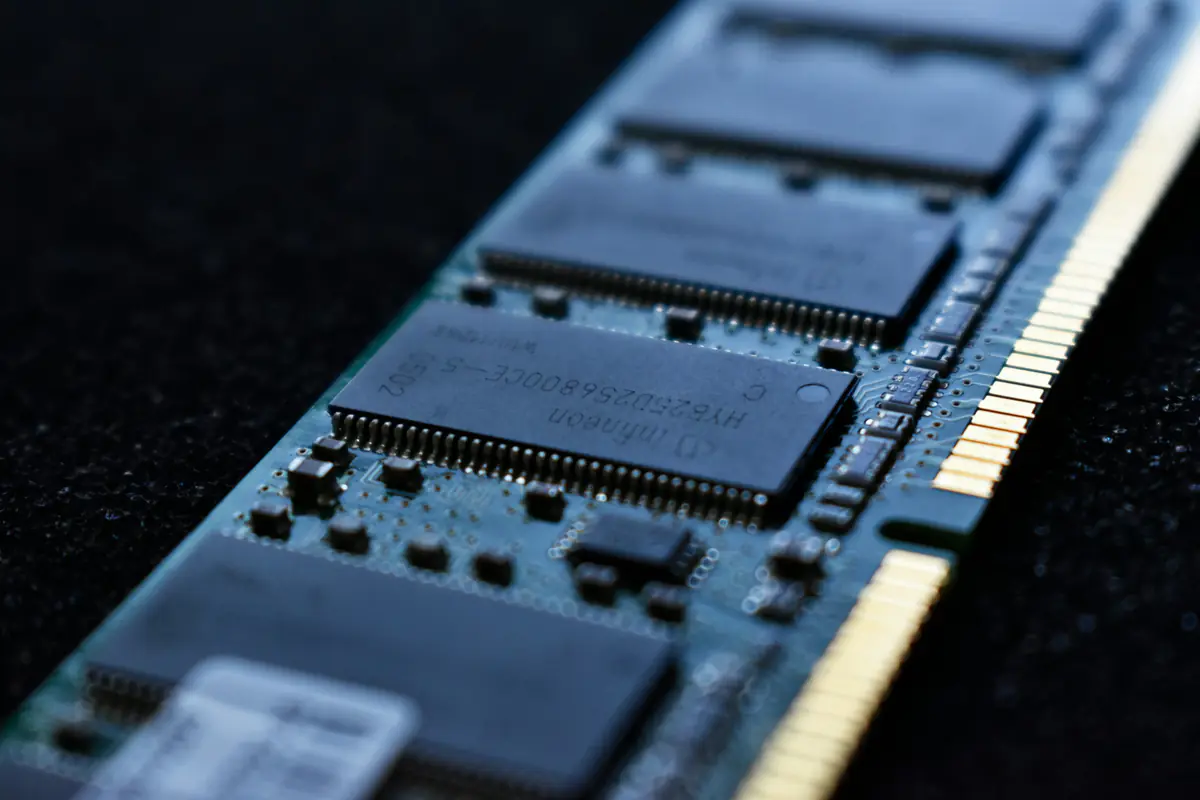
The core problem it targets is memory. In a large language model, each new token requires reading huge numbers of model weights, and on today’s accelerators the speed at which memory feeds the processor, not the arithmetic itself, often sets the pace. When Fractile came out of stealth in July 2024 it described its approach as in-memory compute: circuits that perform the operations next to where the data sits, so parameters do not have to shuttle between memory and processor chips. Fortune reported at the time that the design places stored data directly beside the transistors doing the arithmetic, avoiding trips to off-chip DRAM.
The design has since moved on. TechCrunch reported this week that, after a pivot, Fractile’s chip centres on DRAM stacked on top of each chip, an attempt to avoid the usual trade-off between fast memory and large capacity. The company is also building a machine learning compiler, the software layer that maps models onto its silicon. Our explainer on high-bandwidth memory in AI chips covers why stacking memory close to compute matters.
Founder, team and funding history
Fractile was founded in the summer of 2022 by Walter Goodwin, who completed a PhD at the University of Oxford’s Robotics Institute; Fortune described him as 28 when the company emerged in 2024. At that point it had 14 employees, including senior hires from Nvidia, Arm and Imagination, according to Fortune and Tech.eu. Its job listings now span London, Bristol, San Francisco and Taipei, per Tech.eu.
The money has grown quickly:
- July 2024, seed: $15 million, co-led by Kindred Capital, the NATO Innovation Fund and Oxford Science Enterprises, with Cocoa and Inovia Capital. Angels included Acorn co-founder Hermann Hauser, Stan Boland and Wayve co-founder Amar Shah. Total funding then stood at $17.5 million.
- February 2026, UK expansion: Fractile pledged to invest £100 million over three years in London and Bristol, including a new Bristol hardware engineering site where engineers will integrate its chips into complete systems and run a software test lab. AI minister Kanishka Narayan announced it, City AM reported.
- May 2026, Series B: $220 million, led by Accel, Factorial Funds and Founders Fund, with Conviction, Gigascale, O1A, Felicis, Buckley Ventures and 8VC. Bloomberg, as relayed by The Next Web, put the valuation at roughly $1 billion.
- November 2026, Series C: more than £500 million at over £5 billion, according to the government, with CapitalG, Lightspeed and Redpoint named among the investors alongside Sovereign AI and the British Business Bank.
Fractile’s website now lists more than 25 backers, from Thrive Capital and BlackRock to the NATO Innovation Fund.
The Anthropic deal and what the company claims
In August, Bloomberg reported that Fractile had reached an initial agreement to sell about $250 million of chips to Anthropic, and that the chips would not be ready for use until 2027. Both companies declined to comment, so the deal remains a press report rather than an announced contract.
Every performance figure about Fractile comes from the company. In 2024 it targeted inference up to 100 times faster and 10 times cheaper than existing hardware, and 20 times the performance per watt of any system it knew of. Fortune noted those numbers came from computer simulations and that Fractile had not yet made test chips. In May, Goodwin argued that frontier models run at around 40 tokens per second on existing chips, which makes very long reasoning tasks slow. No independent measurement of Fractile silicon has been published, and the architecture those 2024 targets described has since changed.
How Fractile compares with other inference-chip start-ups
Fractile is entering a crowded field. The table sets out facts we could verify from company statements and reporting; it compares business positions, not chip performance.
| Company | Base | Approach (company’s description) | Latest verified milestone | Products shipping? |
|---|---|---|---|---|
| Fractile | London and Bristol, UK | Inference chips and systems; DRAM stacked on each chip (TechCrunch) | Series C over £500m at over £5bn, November 2026 (GOV.UK) | No; first chips and systems planned for 2027 |
| Groq | US | Pioneered the LPU; runs an inference cloud | Non-exclusive licensing deal with Nvidia, December 2025; founder Jonathan Ross moved to Nvidia | Yes, via its cloud service |
| Cerebras | Sunnyvale, US | Wafer-scale processor (WSE-3) | Nasdaq IPO, May 2026: $5.5bn raised at a $56.4bn fully diluted valuation | Yes |
| d-Matrix | Santa Clara, US | Digital in-memory compute; Corsair accelerators | $275m Series C at $2bn, November 2025 | Corsair announced as a product line |
| Etched | San Jose, US | “Frontier inference clusters”; A0 silicon on TSMC N4P | $700m at a $21bn valuation led by Jane Street (company site) | Company cites over $1bn in customer contracts |
| Tenstorrent | US | AI processors and Galaxy servers | $1.5bn at $6.2bn, October 2026 | Yes |
Two patterns stand out. First, Fractile’s valuation sits in the same range as Tenstorrent, which raised $1.5 billion at $6.2 billion last month, even though Tenstorrent already sells servers and Fractile has no product on the market. Second, the field has already seen one exit route other than an IPO: Groq licensed its technology to Nvidia and its founder joined Nvidia, while Groq continued as an independent company.
Why the UK government is backing it
Fractile fits squarely into Britain’s push for “sovereign” AI capability, which we cover in our explainer on what sovereign AI means. In June, the government’s £1.1 billion AI Hardware Plan named Fractile and Olix as examples of British chip start-ups, and earmarked £150 million to buy next-generation inference chips as an early customer, part of a planned national AI supercomputer. This week’s announcement framed the Fractile investment as reducing dependence on overseas technology and keeping jobs in Britain; Business Secretary Jonathan Reynolds pointed to the company’s plans to expand in Bristol. The government also noted that the Budget a fortnight earlier added £140 million for Sovereign AI.
Risks to keep in mind
- No shipping product yet. Plans have moved before: the 2024 pitch centred on in-memory compute, while this week’s reporting describes a DRAM-stacked design.
- Execution and manufacturing. First silicon, packaging and full systems all have to work, with 2027 as the stated target.
- Customer concentration. The one reported customer deal, with Anthropic, is unconfirmed by either side.
- Software. Nvidia’s lead rests heavily on its software ecosystem, as we explain in why Nvidia dominates AI; Fractile’s compiler must make its chips easy to adopt.
- Valuation pressure. The company’s value rose several-fold in six months, according to reported figures, before any revenue from chips.
What to watch next
- Whether Fractile publishes measured results from its first silicon, and whether they are verified independently.
- Any confirmation from Anthropic or Fractile of the reported $250 million chip order.
- Progress on the Bristol systems facility and UK hiring promised in February.
- Whether Fractile hardware is chosen for the UK’s planned national AI supercomputer or its early inference-chip purchases.
Key takeaways
- Fractile raised a Series C of more than £500 million at a valuation above £5 billion, with UK state-backed investors joining.
- The company designs inference chips and systems; its first products are due in 2027.
- Its design has shifted from 2024’s in-memory compute pitch to DRAM stacked on each chip, according to TechCrunch.
- All performance claims so far are the company’s own, and the reported Anthropic order is not officially confirmed.
- Its valuation now rivals that of Tenstorrent, which already sells hardware.
Frequently asked questions
What does Fractile make?
Fractile designs chips and complete systems for AI inference, the work a model does each time it answers a request. It is also building a compiler to run large language models on its hardware.
Who founded Fractile?
Walter Goodwin, who holds a PhD from the University of Oxford’s Robotics Institute, founded Fractile in 2022 and is its chief executive.
When will Fractile’s chips be available?
Goodwin has said the Series C funding will let Fractile ship its first chips and systems in 2027. No chips have been sold commercially yet.