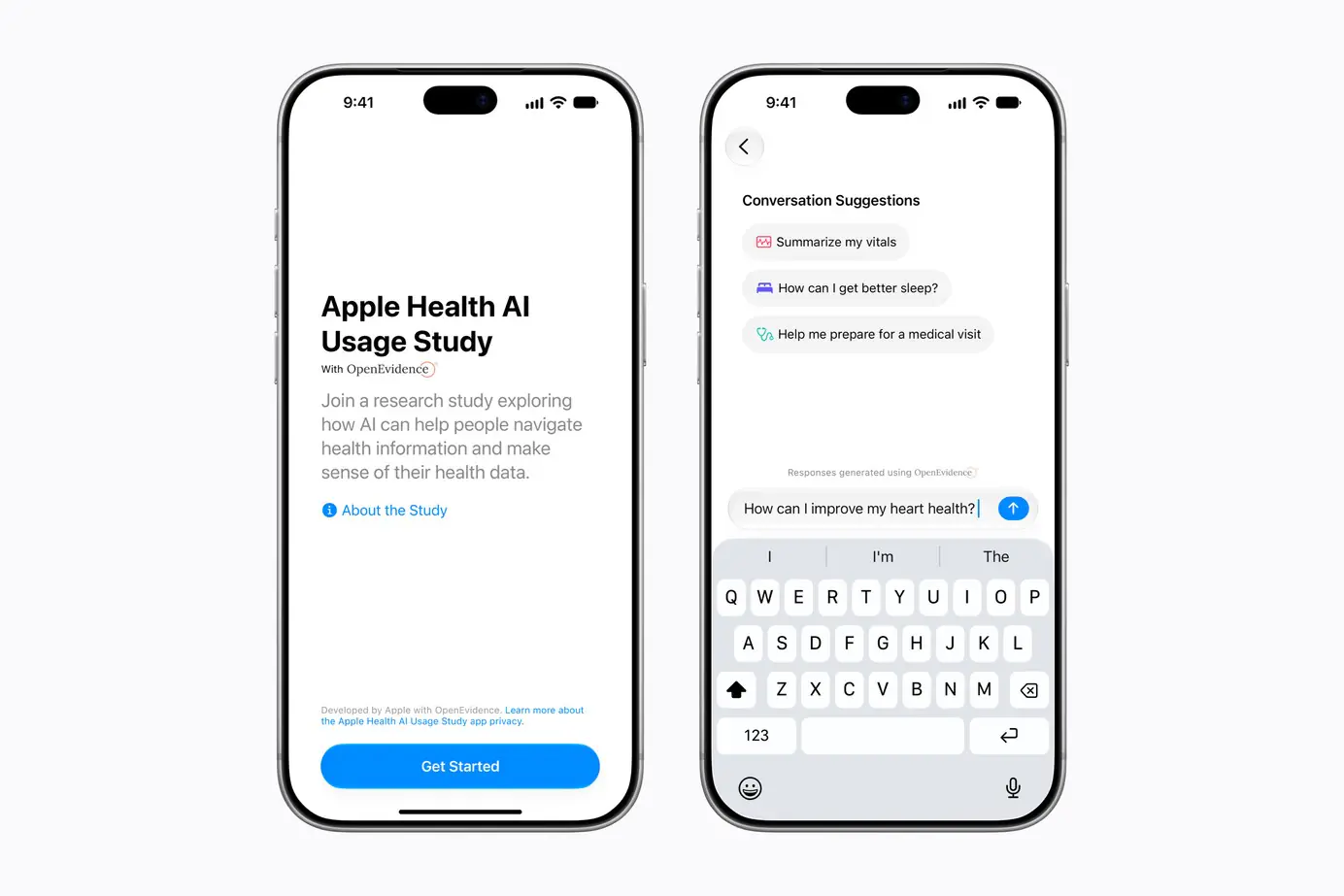
Apple on November 15, 2026 launched the Apple Health AI Usage Study, a virtual research study and iPhone app that lets up to 200,000 adults in the United States ask everyday health questions to an AI system built with clinical-search company OpenEvidence. The study will measure what makes people trust health answers, how well they understand them and what they do next. Apple says study data will not be used to train AI models. It is the company’s most direct public step yet toward conversational health AI, and it begins as a controlled experiment rather than a consumer feature.
What Apple announced
The study runs in a dedicated app. Participants type health questions and get answers written in plain language, with links to the peer-reviewed clinical sources behind each one. The answers come from OpenEvidence, a clinical AI platform widely used by doctors that draws on published medical literature, including the New England Journal of Medicine, JAMA and Nature. Apple designed the research experience around it.
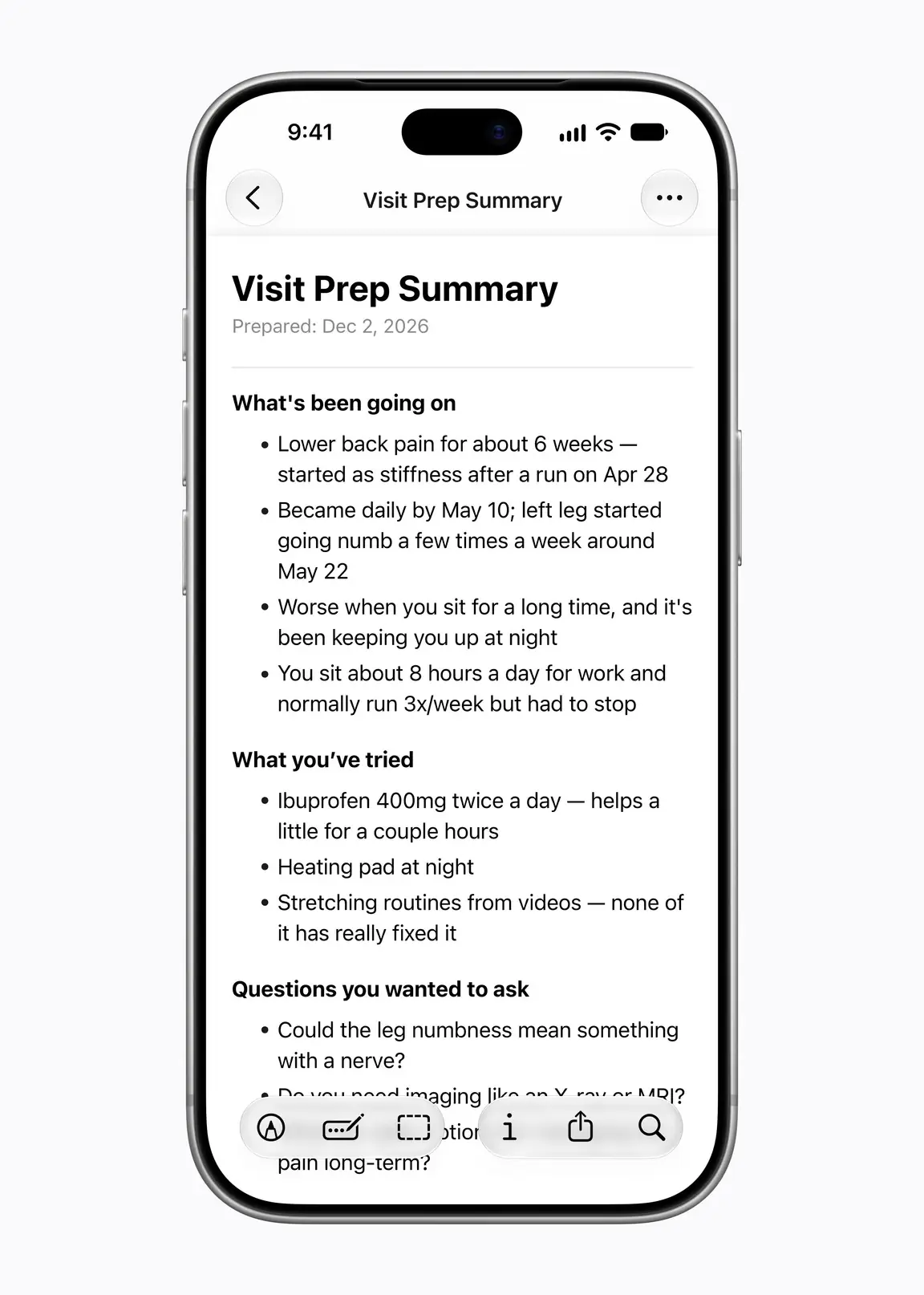
Participants can choose to share selected HealthKit data, such as resting heart rate, activity, sleep or lab results, so researchers can test whether personal context makes answers more relevant and easier to understand. The study will also look at whether the tool helps people prepare for appointments with their own doctors.
Apple’s vice president of Health and Fitness, Sumbul Desai, framed the project as a way to bring “scientific rigor and clinical grounding” to the field. UCSF’s chair of medicine, Robert Wachter, said in Apple’s announcement that patients and clinicians are turning to AI tools that are “being built and tested in separate worlds.”
Who can join
Enrollment is limited to:
- adults aged 21 or older living in the United States;
- a total of up to 200,000 participants;
- people with an iPhone that supports Apple Intelligence (iPhone 15 Pro or later) running iOS 26 or later.
Apple says the app is not meant to diagnose or treat any condition, and that participants should talk to a doctor or clinician about medical decisions.
Privacy and safety guardrails
Health questions are among the most sensitive things people type into a chatbot, so the data rules matter here. Apple says:
- study data will not be used to train AI models;
- participants decide whether to share any HealthKit metrics or survey answers;
- Apple has security measures in place to protect the study data it holds and participants’ confidentiality;
- the app tries to detect certain concerning questions and suggests following up with a provider or other resources.
Apple also acknowledges that health tools based on large language models can give answers that are incomplete or unclear. That is the main reason it gives for running a formal study before shipping anything wider.
How it differs from asking a general chatbot
Most people who ask health questions today use general-purpose assistants. Those assistants answer from a broad training set, usually do not show which clinical source supports each statement, and are governed by the provider’s normal privacy terms. Our guide on what happens to what you tell an AI chatbot explains how those terms usually work.
Apple’s study changes three things. The answers are grounded in a clinical literature engine with linked citations. Personal health data is optional and limited to the HealthKit types the user chooses to share. And the whole setup is run as research with a defined group of participants and a stated data policy. That makes it closer to a clinical-evidence tool for patients than to a general chatbot. The risks described in our overview of AI in healthcare and its regulation, such as confident wrong answers and over-reliance, are exactly what the study is designed to measure.
What it means for Apple and the industry
Apple has not said whether the study will lead to a health assistant in the Health app or in Apple Intelligence. Apple says the findings should inform “the responsible design of health AI experiences for Apple and the industry,” which suggests it plans to publish results. For OpenEvidence, whose users so far have mostly been clinicians, the study is a large test with consumers. For health systems, a tool that helps patients turn up to appointments with better-organized questions could save time, if the answers prove reliable.
What to watch next
- Whether Apple publishes study results, and how it measures trust and comprehension.
- Any move to bring a similar assistant into the Health app or Apple Intelligence outside the study.
- How regulators treat consumer health assistants that draw on personal health data.
- Similar consumer projects from OpenEvidence or competing clinical AI providers.
Key takeaways
- Apple launched the Apple Health AI Usage Study in the United States on November 15, 2026.
- Up to 200,000 adults aged 21 or older can join with an iPhone 15 Pro or later running iOS 26 or later.
- Answers come from OpenEvidence and include links to peer-reviewed clinical sources.
- Sharing HealthKit data is optional, and Apple says study data will not train AI models.
- The app does not diagnose or treat conditions; it is a research study, not a product launch.
Frequently asked questions
What is the Apple Health AI Usage Study?
It is a virtual research study and iPhone app from Apple, run with OpenEvidence, that lets participants ask health questions and studies how they trust, understand and act on the AI’s answers.
Who can join Apple’s health AI study?
Adults aged 21 or older in the United States with an Apple Intelligence-capable iPhone (iPhone 15 Pro or later) running iOS 26 or later can enroll, up to a total of 200,000 participants.
Will Apple use my health data to train AI?
Apple says data from the study will not be used to train AI models. Participants choose whether to share HealthKit data or survey answers at all.