
Google on Wednesday, November 11, launched the Gemini Decisions API and a new model behind it, Gemini Decision 1 (gemini-decision-1). Instead of writing text, the model answers up to 1,000 yes/no, multiple-choice or rubric-scoring questions about one input in a single pass and returns probabilities and confidence scores. It costs $0.10 per million input tokens with no output charge, and Google says it is nearly five times cheaper than running the same work on Gemini 3.5 Flash-Lite.
What Google launched
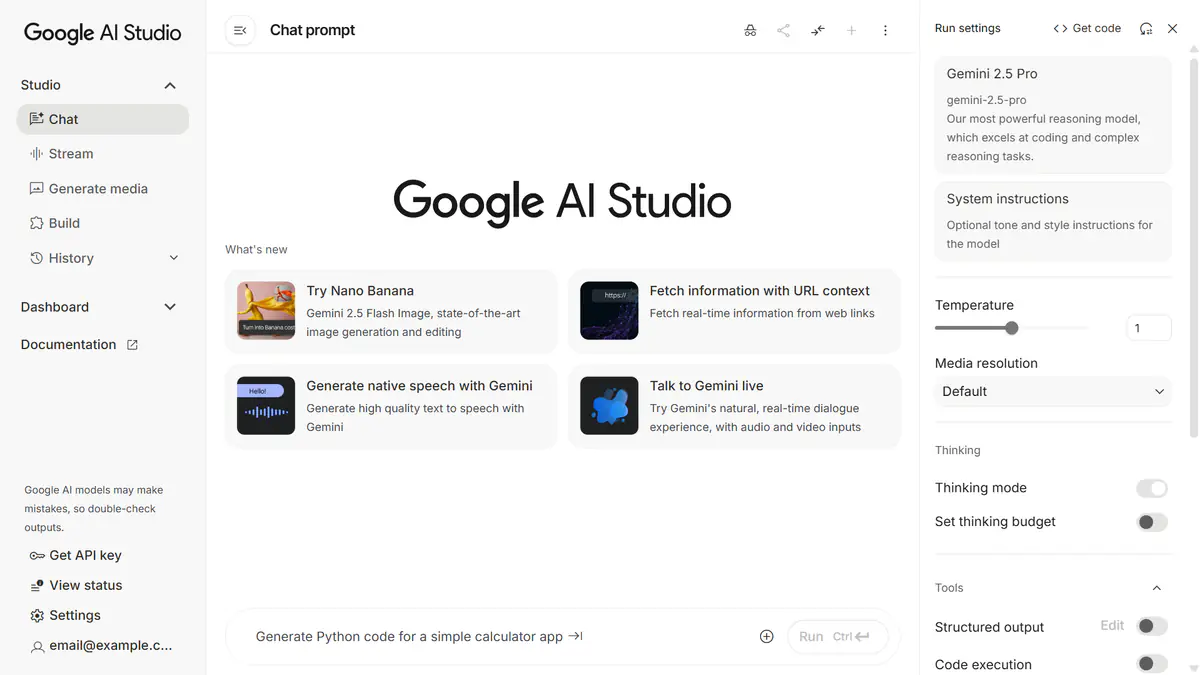
The API is available now through the Gemini Developer API and Google AI Studio, with a no-cost tier for prototyping. Support for Gemini in Google Cloud is “coming soon.”
According to the documentation, a request can hold up to 262,144 tokens of text, images, audio, video and PDFs, shared by the input and all questions. Each question is one of three types: noul (yes/no, returning the probability of “yes”), choice (2 to 255 options) or score (2 to 255 ordered levels). Google reports 150 to 250 milliseconds end to end, with latency nearly flat from 1 to 100 questions. Context caching and the Batch API are not supported.
Google claims the lowest calibration error on its own benchmark suites, but publishes the scores only as charts.
How a decision model differs from a chat LLM
A chat model writes its answer token by token, so getting a clean label means parsing replies and handling invalid ones. Google says Gemini Decision 1 instead scores the candidate options in one forward pass and returns a typed object per question, never free text; output token usage is always zero.
Two design choices matter for cost. The shared input, such as a call recording with account metadata, is billed once per request however many questions are asked. And every answer carries a confidence value, so an application can act on confident answers and send the rest to a larger model or a person. Google already uses it in Gemini Notebook to route queries between model tiers, which it says cut latency by up to 40% for everyday queries, and as a safety layer for MCP tools in Google Search. Thoughtworks, whose November 4 Technology Radar lists decision models under “Assess,” advises defining evaluation criteria before replacing an LLM.
What it costs compared with Gemini 3.5 Flash-Lite
On Google’s paid tier, Gemini Decision 1 costs $0.10 per million input tokens for every modality. Gemini 3.5 Flash-Lite costs $0.30 per million input tokens and $2.50 per million output tokens, thinking tokens included. At list prices, a workload that sends 500 million input tokens costs $50 on Decision 1 and $150 on Flash-Lite before Flash-Lite’s output is counted. The trade-off: Decision 1 cannot explain itself, extract values or write a reply.
How it compares with OpenAI’s Decisions API and Jev
TypeSafe AI’s Jev opened this category in mid-September, according to SiliconANGLE, and OpenAI’s Decisions API followed in October.
| Gemini Decision 1 | OpenAI Decisions API | TypeSafe Jev | |
|---|---|---|---|
| Input price | $0.10 per 1M tokens | $0.10 per 1M uncached tokens | $42 per 1B tokens |
| Questions per request | Up to 1,000 | Up to 400 | Not listed |
| Input types | Text, image, audio, video, PDF | Text, images, JSON | Structured input |
OpenAI’s service runs on gpt-6-luna and discounts prompt-cache hits, which Google does not offer. According to SiliconANGLE, Google says its model beat OpenAI’s on seven of nine benchmarks but found Jev slightly more cost-efficient. Others have taken different routes: Cloudflare open-sourced its Clef decision models alongside the Clairic extraction model, and IBM built a Decision adapter into Granite Switch 4.1. Google’s pricing contrasts with frontier releases such as Gemini 4 Argon.
What to watch next
- When Gemini in Google Cloud gets support, which Google has only described as coming soon.
- Independent calibration and accuracy tests, since Google’s scores are charts only.
- Whether Google adds context caching or Batch API support.
Key takeaways
- Gemini Decision 1 returns probabilities and confidence scores for yes/no, choice and score questions instead of text.
- It costs $0.10 per million input tokens with no output charge, a third of Flash-Lite’s input price.
- Google says it is nearly 5x cheaper than Flash-Lite on its benchmark suite.
- It matches OpenAI’s input price, while Jev lists $42 per billion tokens.
Frequently asked questions
What is Gemini Decision 1?
Gemini Decision 1 is a Google model that answers structured questions instead of generating text. It returns a probability, choice or score plus a confidence value for each question and powers the Gemini Decisions API.
How much does the Gemini Decisions API cost?
The paid tier costs $0.10 per million input tokens for all input types, and output is not charged because the model generates no text. Google AI Studio also offers a free tier.
When should I use a decision model instead of an LLM?
Decision models suit high-volume tasks with a fixed answer set, such as moderation, routing and grading. Tasks that need explanations, extracted values or written replies still need a generative model.