
LangChain, the company behind the open-source LangChain and LangGraph libraries, said on November 13 that it has raised $300 million in a Series C round at a $3 billion valuation. Existing investor CapitalG, Alphabet’s growth fund, led the round. The valuation is more than double the $1.25 billion LangChain was given when it raised $125 million about a year ago, according to TechCrunch, and it is a bet that companies will want agent infrastructure that is not tied to a single model lab or cloud.
Who invested
New investors GIC, Singapore’s sovereign wealth fund, and DFJ Growth took significant stakes, alongside existing backers IVP and Sapphire Ventures. LangChain also named Salesforce Ventures, Insight Venture Partners, QuantumLight and MongoDB Ventures as new participants, and said Sequoia, Amplify and Benchmark increased their positions. TechCrunch reports that IVP led the previous round.
What LangChain sells now
LangChain started in 2022 as an open-source project that helped early language models do things they were bad at on their own, such as searching the web, calling APIs and querying databases. As frontier labs built those abilities into their own tools, the company shifted toward managing agents in production. Its commercial product is LangSmith, which it calls a framework-agnostic platform to run, improve and govern agents.
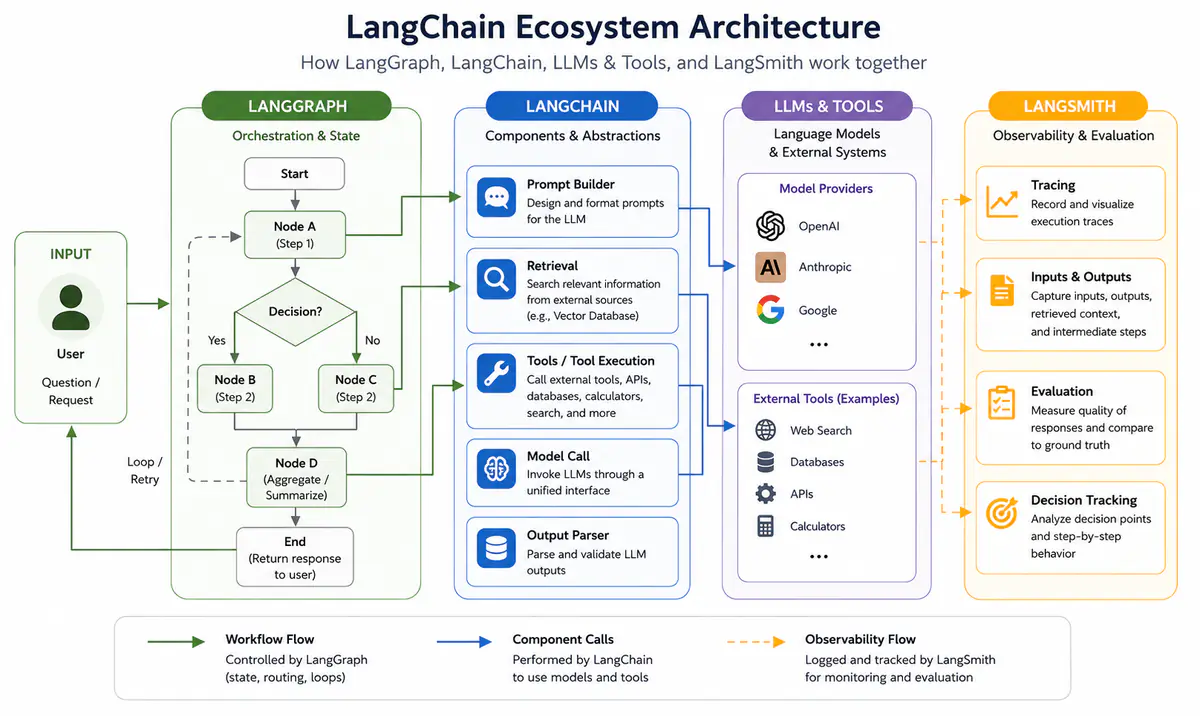
The company groups LangSmith into three parts:
- Agent runtime: the open-source Deep Agents, LangGraph and LangChain libraries, plus LangSmith Agent Server and Sandboxes for running agents in the cloud or on a customer’s own systems, and fully managed options called Managed Agents and Fleet.
- Agent improvement: observability and evaluation tools, an in-platform agent called LangSmith Engine that looks for errors and proposes code and prompt fixes, and a fine-tuning service that turns agent traces into training data.
- Agent governance: gateways that control which models and tools agents may use, manage model budgets and fallbacks, and protect sensitive data.
The customer numbers behind the valuation
LangChain says more than 7,000 organizations use LangSmith. It names startups such as Harvey, Rippling and Listen Labs and large companies including NVIDIA, Toyota and Salesforce. Two examples stand out in the announcement: Clay monitors hundreds of millions of agent runs per month in LangSmith, and Workday says it cut the time to deploy a new agent from five months to under a day. Those figures come from LangChain and have not been independently verified.
The pitch is control. The company’s slogan for the round is that every company should “own its intelligence”: choose models freely, keep data and infrastructure under its own control, and keep improving its agents over time.
How it compares with the labs’ own agent platforms
LangChain’s main competition is no longer other open-source frameworks but the model makers themselves. OpenAI has been pushing its own agent tools into businesses, most recently with ChatGPT Business agents and a Business Hub beta. Anthropic, Google and the large clouds offer their own agent runtimes and tracing tools, usually tuned to their own models.
| Approach | Example | Main trade-off |
|---|---|---|
| Lab-native agent platform | OpenAI, Anthropic and Google agent tools | Tight model integration, but tied to one provider |
| Cloud agent runtime | Managed agent services on the major clouds | Fits existing cloud contracts, but tied to one cloud |
| Independent platform | LangSmith | Works across models and clouds, but adds another vendor |
The argument for an independent layer is that most large companies already use several models and want one place to trace, test and govern all of their agents. The argument against is that each lab keeps shipping better built-in tooling, which shrinks the space a third party can fill. TechCrunch notes that newer startups are pitching similar model-neutral platforms.
What it means for teams building agents
For developers already using LangGraph or LangChain, the round suggests the open-source libraries will keep getting investment, since they feed the paid platform. For buyers, the questions are the usual ones for any agent platform: how traces and evaluation data are stored, whether the platform can run inside your own cloud, and what it costs at the volume of agent runs you expect. Our explainer on how to evaluate AI agents for workflow automation covers the checks to run before committing.
What to watch next
- The LangSmith release event on November 20, where LangChain says it will show new capabilities.
- Whether LangChain uses the money for acquisitions in evaluation, security or agent hosting.
- How the labs respond as more enterprises adopt model-neutral agent tooling.
- Pricing changes for LangSmith as managed agents and fine-tuning move into the core product.
Key takeaways
- LangChain raised $300 million at a $3 billion valuation, led by CapitalG.
- The valuation more than doubles the $1.25 billion set about a year ago.
- LangSmith, its platform to run, improve and govern agents, is used by more than 7,000 organizations, the company says.
- LangChain’s pitch is model and cloud neutrality against agent platforms built by the labs and clouds.
- New LangSmith features are due at an event on November 20.
Frequently asked questions
What is LangChain?
LangChain is a San Francisco company that maintains the open-source LangChain, LangGraph and Deep Agents libraries for building AI agents, and sells LangSmith, a platform for deploying, monitoring, evaluating and governing those agents.
How much is LangChain worth?
LangChain was valued at $3 billion in its $300 million Series C, announced on November 13, 2026. That is more than double the $1.25 billion valuation from its previous round about a year earlier.
Is LangChain free to use?
The LangChain, LangGraph and Deep Agents libraries are open source and free. LangSmith, the company’s hosted and self-hosted platform for running and monitoring agents, is a commercial product.