AMI Labs (Advanced Machine Intelligence) is the Paris-based start-up that Turing Award winner Yann LeCun co-founded after leaving Meta at the end of 2025, and it is the best-funded attempt to build AI around “world models” rather than large language models. It announced a $1.03 billion seed round in March 2026 at a reported $3.5 billion pre-money valuation, and this autumn its researchers have co-authored a run of preprints on JEPA world models that plan robot and navigation tasks in a learned latent space. This profile explains who runs the company, what it is building and how its approach differs from the chatbot labs.
Founding, leadership and funding
LeCun spent 12 years shaping AI research at Meta, where he founded the FAIR lab, before leaving at the end of 2025. He has said for years that language models alone will not reach human-level intelligence, and he named Meta’s growing focus on them as one reason for his departure, according to The Decoder. Our profile of the godfathers of deep learning, Hinton, LeCun and Bengio covers his earlier work on convolutional networks.
At AMI Labs he is executive chair and keeps his professorship at New York University. The chief executive is Alexandre LeBrun, who previously led the health AI company Nabla and worked at FAIR. TechCrunch reported the rest of the leadership team in March: Laurent Solly, formerly Meta’s vice president for Europe, as chief operating officer; Saining Xie as chief science officer; Pascale Fung as chief research and innovation officer; and Michael Rabbat, a long-time FAIR researcher, as vice president of world models in Montreal.
The $1.03 billion seed round, which Tech.eu described as the largest ever for a European start-up, was co-led by Cathay Innovation, Greycroft, Hiro Capital, HV Capital and Bezos Expeditions. Nvidia, Samsung, Temasek, Toyota Ventures and Bpifrance’s digital venture fund also invested, along with individuals including Tim Berners-Lee, Eric Schmidt and Xavier Niel. The company is headquartered in Paris and is building teams in New York, Montreal and Singapore.
AMI Labs has said it has no plans to generate revenue for now. It describes its work as fundamental research, promises to publish papers and open-source much of its code, and named Nabla as its first disclosed partner, with early access to its models.
The JEPA research line it inherits
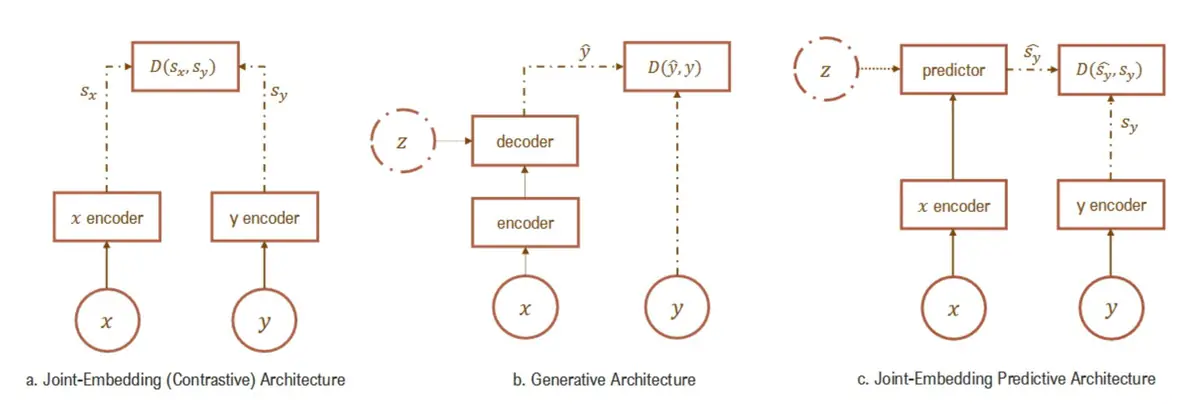
The company’s technical bet is the Joint Embedding Predictive Architecture, which LeCun proposed in 2022. A generative model learns by reconstructing its input, pixel by pixel or token by token. A JEPA instead encodes both a context and a target into abstract representations and learns to predict the target’s representation from the context’s. The idea is that the model can ignore details that cannot be predicted, such as the exact movement of leaves in the wind, and concentrate on the structure that matters for understanding and planning.
Meta’s FAIR team built the main public milestones:
- I-JEPA (arXiv 2301.08243, January 2023) learned image representations by predicting the representations of masked blocks of an image, without hand-crafted data augmentation. The authors trained a ViT-Huge/14 on ImageNet with 16 A100 GPUs in under 72 hours.
- V-JEPA (arXiv 2404.08471, 2024) applied feature prediction to video, training on 2 million public videos without text, negative examples or pixel reconstruction. Its largest model reached 81.9% on Kinetics-400 with a frozen backbone.
- V-JEPA 2 (arXiv 2506.09985, June 2025) pre-trained on more than 1 million hours of internet video, then post-trained an action-conditioned version, V-JEPA 2-AC, on fewer than 62 hours of unlabeled robot video from the DROID dataset. Meta reported zero-shot pick-and-place on Franka robot arms in two labs, using planning towards image goals.
Several of the authors on those papers, including Rabbat, now appear on preprints with AMI Labs affiliations.
What the new studies claim
The Decoder this week framed three studies from Meta and AMI Labs as evidence for LeCun’s approach. Three recent arXiv preprints that list AMI Labs or Advanced Machine Intelligence as an affiliation show where the research is heading. None has been peer-reviewed yet.
H-JEPA (arXiv 2610.06805), by Wancong Zhang, Basile Terver, Michael Rabbat, Yann LeCun and Randall Balestriero, trains a hierarchy of action-conditioned JEPAs in which each level predicts further ahead in its own latent space. Planning runs top-down, with each level’s predictions becoming sub-goals for the level below. On a simulated Visual AntMaze task, a three-level hierarchy raised success from 18% to 73% while using less planner compute than a flat JEPA.
Hierarchical World Models with Implicit Dynamics (arXiv 2610.42146), whose authors span Meta FAIR and AMI Labs, introduces ID-WM. A high-level model samples reachable transitions and a low-level world model works out the actions needed to reach them. The authors report a 38.5% improvement over state-of-the-art policy and diffusion planners across three navigation and manipulation suites, and a 135% gain over single-level world-model planning.
Counterfactual World Models (arXiv 2611.24778), by Balestriero, LeCun and Kerda Varaku, asks what would have happened under a different action given the same hidden disturbance. The paper proves that world models trained only on observed transitions cannot answer this on their own. It then derives a correction that works for many physical systems without counterfactual data or retraining. On four rendered simulators, counterfactual R² rose from 38–46% to 86–96%.
The common thread is long-horizon planning: getting a model that predicts in latent space to chain many short predictions without errors piling up.
How the JEPA approach compares with LLM-centred labs
The contrast with labs such as OpenAI and Anthropic is mostly about the training signal and the target domain:
- What is predicted. LLMs predict the next token of text; JEPAs predict abstract representations of future observations. LeCun argues that text alone lacks most of what a person learns about the physical world.
- What is generated. Generative world models such as Google DeepMind’s Genie line, which we covered in our report on Genie 4, render pixels you can watch. A JEPA does not have to produce an image at all, which saves compute but makes its “imagination” harder to inspect.
- Where results are measured. LLM labs report coding, maths and agent benchmarks. JEPA papers report robot success rates, video understanding and planning compute in simulators, so the two camps rarely compete on the same leaderboard.
- Business model. The chatbot labs sell subscriptions and API access today. AMI Labs has said it will not seek revenue for now and expects commercial uses in robotics, industry and wearable devices to take years.
It is also a crowded niche. Fei-Fei Li’s World Labs, profiled in our article on her career, Nvidia’s Cosmos tools and DeepMind all pursue world models with different methods. Our glossary entry on world models explains the general concept.
What to watch next
- Whether AMI Labs releases model weights or code for H-JEPA, ID-WM or a successor, as it has promised to open-source much of its work.
- Real-robot results beyond simulators, the test that matters most for its industrial and robotics ambitions.
- Peer review of the autumn preprints, likely at 2027 machine learning conferences.
- New partners after Nabla, and whether any investor such as Toyota Ventures or Samsung turns into a deployment customer.
- Hiring and research output from the Montreal, New York and Singapore teams.
Key takeaways
- AMI Labs is a Paris start-up co-founded by Yann LeCun, with Alexandre LeBrun as CEO and LeCun as executive chair.
- It raised a $1.03 billion seed round in March 2026, reported as Europe’s largest, at a $3.5 billion pre-money valuation.
- Its research builds on Meta’s I-JEPA, V-JEPA and V-JEPA 2, which predict representations rather than pixels or tokens.
- Recent preprints with AMI Labs affiliations focus on hierarchical and counterfactual planning, with large gains in simulated tasks; none is peer-reviewed yet.
- The company has no revenue plans for now and targets robotics, industry and wearables over chatbots.
Frequently asked questions
What is AMI Labs?
AMI Labs, short for Advanced Machine Intelligence, is a Paris-based AI start-up co-founded by Yann LeCun. It builds world models that learn how the physical world behaves rather than large language models trained mainly on text.
How much money has AMI Labs raised?
AMI Labs announced a $1.03 billion seed round in March 2026, co-led by Cathay Innovation, Greycroft, Hiro Capital, HV Capital and Bezos Expeditions. TechCrunch reported a $3.5 billion pre-money valuation.
What is a JEPA world model?
A Joint Embedding Predictive Architecture learns by predicting the abstract representation of missing or future parts of its input, instead of reconstructing every pixel or token. Used as a world model, it predicts how a scene’s representation will change after an action, which lets a system plan in that latent space.