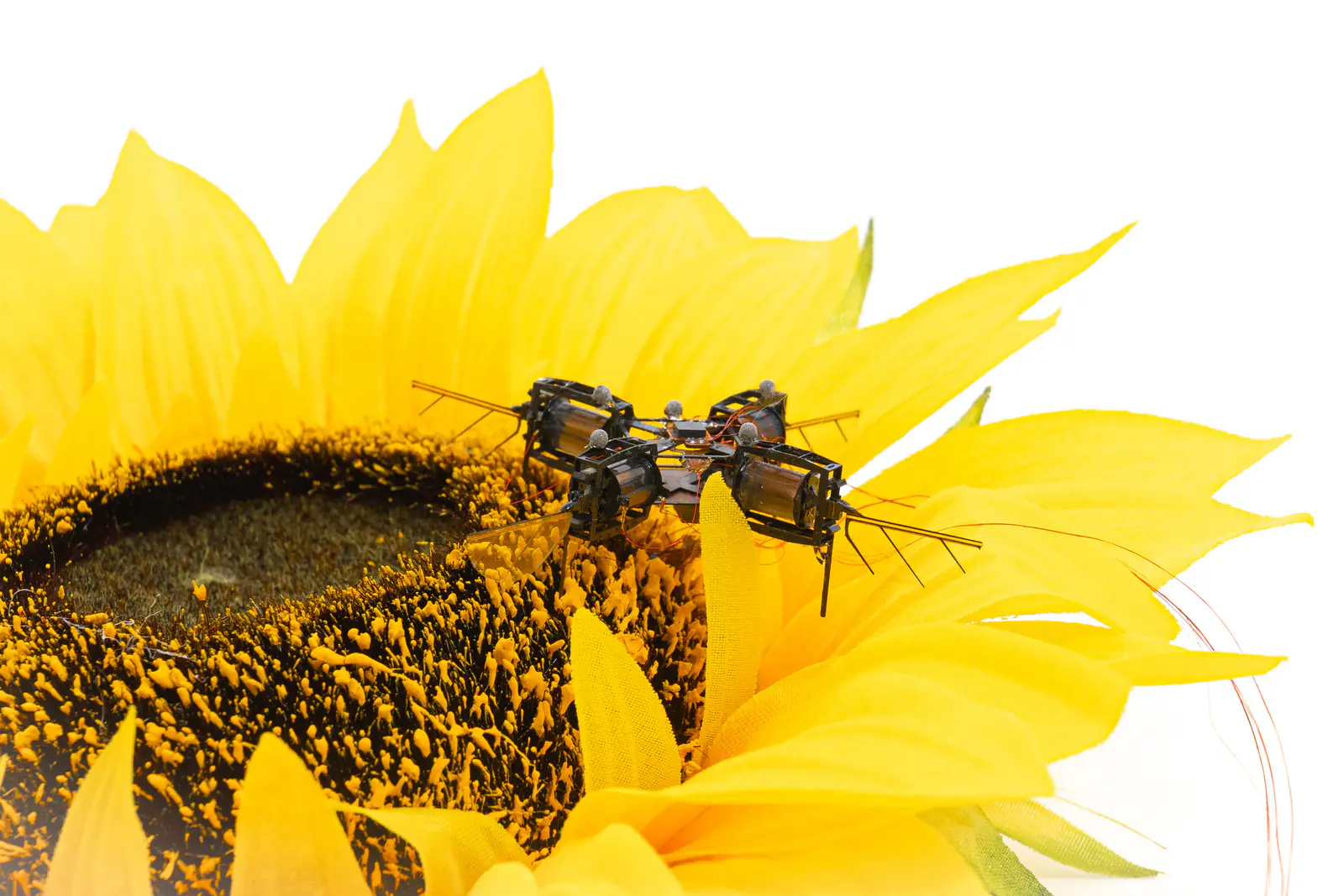
Researchers at MIT have flown an insect-scale, flapping-wing robot that estimates its own position and runs its own flight control, instead of relying on the laboratory motion-capture cameras that such robots have needed until now. The work, published in the peer-reviewed journal Science Robotics on November 18, 2026, describes a robot that weighs less than a paperclip, carries a 244-milligram electronics package and landed on a sunflower outside the lab’s camera-tracked area. It still draws power through a wire, but the team calls it the first aerial microrobot that senses and computes for itself, a step toward uses such as artificial pollination.
What the MIT team built
The robot comes from the Soft and Micro Robotics Laboratory led by Kevin Chen, an associate professor in MIT’s Department of Electrical Engineering and Computer Science. It has four wings, each driven by soft actuators, a kind of artificial muscle, and is about the size of a microcassette.
Earlier versions could not lift the electronics needed to navigate. External cameras tracked the robot and an offboard computer sent it commands, which kept it inside the lab.
MIT graduate students Yi-Hsuan (Nemo) Hsiao, Quang Phuc Kieu and Zhongtao Guan are co-lead authors. The corresponding authors are Chen, MIT’s Jonathan How and Cornell University’s Elizabeth Farrell Helbling.
How it fits sensing and computing on board
The first problem was weight. The researchers made the artificial muscles 50% larger, which raised net lift by 46%, according to MIT. That produced a lift-to-weight ratio of 1.9, enough to carry the 244-milligram package of sensors and a microcontroller.
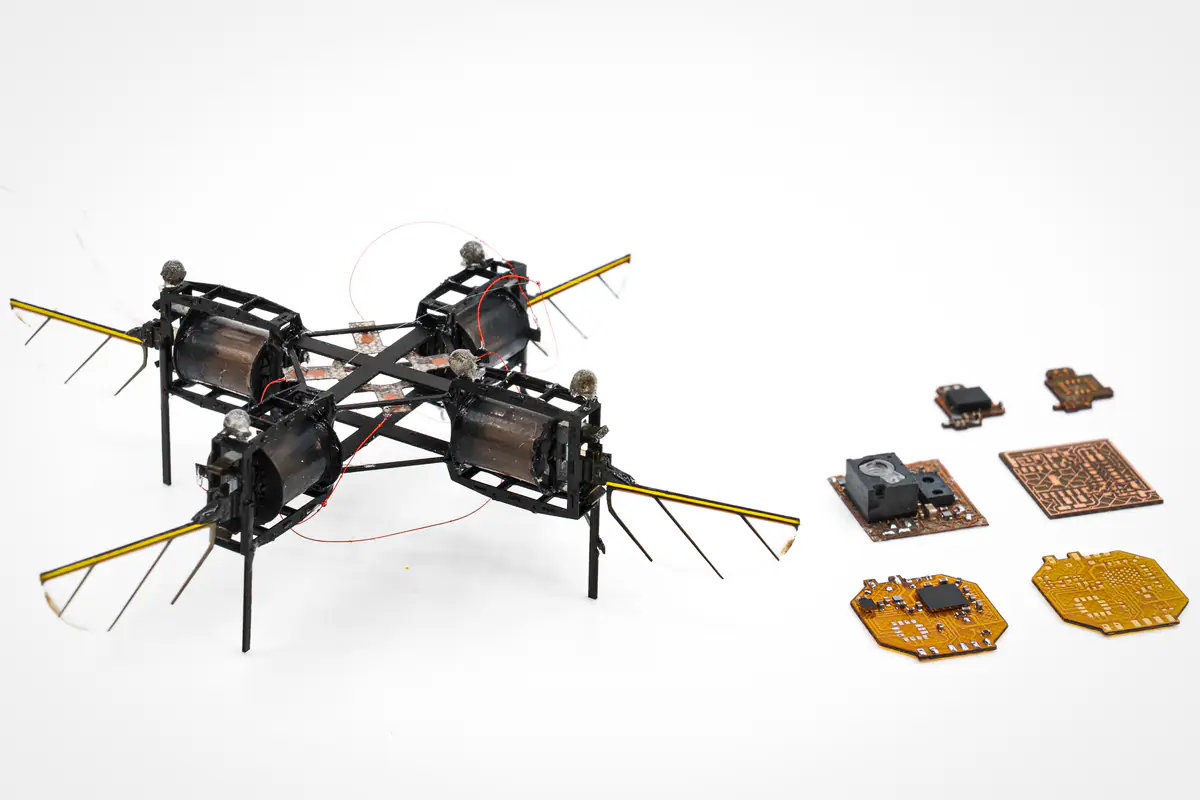
The package holds three sensors: an inertial measurement unit for the robot’s attitude, an optical flow sensor for sideways speed and position, and a time-of-flight sensor for height.
The second problem was drift: without cameras, small position errors add up. The team wrote a simplified algorithm that computes orientation and position very quickly, and found that a fast, slightly less accurate estimate worked better than a slow, precise one. Hsiao told MIT News its positional accuracy is now “comparable to flying with offboard cameras”.
What the flights showed
In tests the robot hovered at several heights and followed point-to-point paths with position errors of a few centimeters, MIT says. In the pollination demonstration, a person used a joystick to send high-level position targets, steering the robot around several plants before it landed on a sunflower.
The robot stabilizes itself and works out where it is, but a human still chose where it should go. It has no camera, so it cannot yet recognize a flower or avoid an obstacle. The electronics used about 6% of the robot’s total power; the rest went to the artificial muscles.
How it compares with earlier insect-scale robots
Three gaps have kept insect-sized fliers in the lab: sensing, computing and power.
- 2013: Harvard’s RoboBee made the first controlled flight of an insect-scale robot, reported in Science. It was tethered for power and control.
- 2019: Harvard’s RoboBee X-Wing made a brief flight without a power tether, using solar cells under bright lamps, as reported in Nature. Helbling was a lead author of that work.
- January 2025: Chen’s lab reported an MIT robot that MIT said flew 100 times longer than earlier versions, still tracked by cameras.
- November 2026: The MIT robot carries sensing and computing on board, with power through a wire.
Larger drones already combine all three, which is why they dominate real deployments, including the heavy hexacopter used to evacuate a wounded soldier in Ukraine. Insect-scale machines aim at delicate plants and tight spaces that a larger aircraft cannot reach.
Why it matters for agriculture and inspection
MIT points to precision agriculture as the main goal. Small fliers could pollinate almond or blueberry blossoms where natural pollinators have declined, or hover near plants to spot pests.
Those uses remain distant. The same gap between a controlled demonstration and outdoor work appears in our explainers on sim-to-real transfer in robot training and on how humanoid robots work.
What to watch next
- An onboard camera, which the team says is its next goal, for object recognition and obstacle avoidance.
- Batteries and power electronics on the robot, the second stated goal, which would allow untethered outdoor flight.
- Lower power use by the electronics, which would free payload for extra parts.
Key takeaways
- MIT’s flapping-wing microrobot now senses and computes on board, using a 244-milligram electronics package.
- Larger artificial muscles raised net lift by 46% and gave a lift-to-weight ratio of 1.9.
- It followed paths with errors of a few centimeters and landed on a sunflower without motion-capture cameras.
- The robot is still tethered for power and was guided by a human with a joystick.
Frequently asked questions
Can the MIT microrobot fly without any wires?
No. It carries its own sensors and computer but still receives power through a wire.
How does the robot know where it is without cameras?
It combines an inertial measurement unit, an optical flow sensor and a time-of-flight height sensor. An onboard microcontroller turns those readings into orientation, speed and position.
What could insect-scale flying robots be used for?
MIT names artificial pollination, crop monitoring and industrial surveillance in places too tight or delicate for larger drones. None has been demonstrated outside a lab.