MLCommons on Monday, November 16, published the results of MLPerf Training v6.1, the industry’s main peer-reviewed benchmark for how fast systems train AI models. The round drew 250 results on 153 systems from 24 organizations, added the suite’s first reinforcement-learning post-training test, and marked the first appearance of Nvidia’s Rubin-generation GPUs and Google’s TPUv7, known as Ironwood. Separately, Nvidia published its first results on MLPerf Endpoints, a newer MLCommons benchmark for agentic inference, but those Vera Rubin figures are still provisional and awaiting peer review.
What is new in Training v6.1
MLCommons added two workloads. The first, Qwen3.5-397B, is a large language model post-training task that uses Group Relative Policy Optimization (GRPO), a reinforcement-learning method, on tasks such as tool calling to solve software engineering problems. MLCommons calls it a first for MLPerf Training. It reflects how much frontier-lab compute now goes into post-training, an approach we explain in our guide to reinforcement learning with verifiable rewards.
The second, DLRMv4-HSTU, replaces the older DLRM-dcnv2 recommender benchmark. It uses the attention-based HSTU architecture and trains on the Yambda dataset, bringing the recommender test closer to how large platforms now build ranking models.
Who took part
According to MLCommons, the 24 submitters were AMD, ASUSTeK, Azure, Cisco, CoreWeave, Crusoe, Dell, Firmus, Fujitsu, Giga Computing, Google, HPE, Inventec, KRAI, Lambda, MiTAC, Nebius, Nvidia, Oracle, Quanta Cloud Technology, Supermicro, tiny corp, TTA and the University of Florida. Crusoe submitted for the first time. Accelerators came from three vendors: Nvidia, AMD and Google.
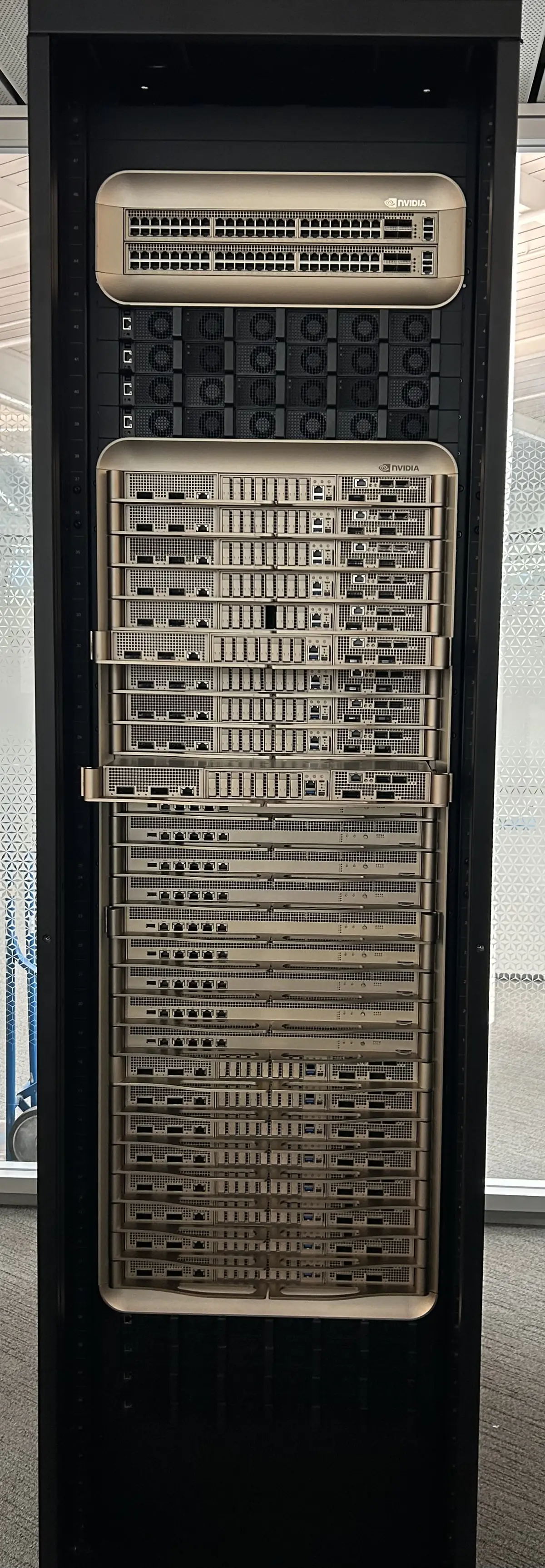
Two trends stand out. Cloud-based systems made up 37% of entries, up from 29% in v6.0, a sign that buyers increasingly rent rather than own training hardware. And 12 systems used 1,000 or more accelerators, with the largest at 10,240. Nvidia says it ran 10,240 GPUs with GB300 systems, and that Microsoft Azure matched that scale with GB200 systems.
Nvidia’s claims, and how to read them
Nvidia says it was the only submitter with results on every benchmark, and that its Vera Rubin NVL72 system delivered up to twice the per-GPU performance of its GB300 NVL72 in this round. On the DeepSeek-V3 benchmark, it reports scaling from 256 to 1,024 Rubin GPUs at about 97% efficiency, cutting time to train from 16 minutes to about four.
These are vendor summaries of peer-reviewed data, and they describe Nvidia’s best comparisons. MLPerf’s value is that the raw results are public: buyers can compare systems of similar scale on MLCommons’ results site rather than rely on per-GPU claims, which depend on how many accelerators each submitter used.
MLPerf Endpoints: a different kind of test
Endpoints, launched by MLCommons this autumn, measures a served inference endpoint, meaning model, hardware, serving software and networking together, across a range of load levels. Instead of one score it reports a frontier of operating points, using metrics such as concurrency, 90th-percentile time to first token, system throughput, throughput per watt of provisioned power, and interactivity in tokens per second per user. Its v1.0 suite has six benchmarks, including multi-turn agentic coding with Kimi K3, Qwen 3.6 and DeepSeek V4 models, checked against SWE-bench Verified tasks so that speed cannot come at the expense of accuracy.
Endpoints uses rolling submissions, and every result carries a status: verified, provisional or unverified. That matters for Nvidia’s headline figure. The company says Vera Rubin NVL72 delivered more than 10 times the throughput per kilowatt of GB300 NVL72 on Kimi K3 at a minimum of 50 tokens per second per user, but its own footnote states the Rubin results are pending MLCommons verification and may change. The GB300 comparison results are verified.
Why this round matters for buyers
For anyone pricing AI infrastructure, the round offers three signals. Post-training is now a benchmarked workload, so claims about reinforcement-learning throughput can be checked. Google’s Ironwood TPU and AMD hardware appear alongside Nvidia, giving at least some cross-vendor data. And Endpoints adds a buyer-oriented view of inference cost per watt, once results pass review. Nvidia’s broader science push at the same conference is covered in our story on Rubin HPC and the Vera CPU rack.
What to watch next
- Verification of Nvidia’s provisional Vera Rubin Endpoints results in a later publication cohort.
- Whether AMD and Google post Endpoints results, giving a cross-vendor comparison for agentic inference.
- Independent analysis of the first Ironwood and Rubin training results on MLCommons’ results site.
- How many submitters tackle the new GRPO post-training benchmark in the next round.
Key takeaways
- MLPerf Training v6.1 has 250 results on 153 systems from 24 organizations.
- New benchmarks: Qwen3.5-397B GRPO post-training and the DLRMv4-HSTU recommender.
- Nvidia Rubin GPUs and Google’s TPUv7 Ironwood appear for the first time; Crusoe is a new submitter.
- Nvidia’s 10x Endpoints efficiency claim for Vera Rubin rests on provisional, not yet verified, results.
Frequently asked questions
What is MLPerf Training?
MLPerf Training is a peer-reviewed benchmark suite from the MLCommons consortium that measures how quickly a system trains a set of AI models to a target quality level.
What is MLPerf Endpoints?
MLPerf Endpoints is a newer MLCommons benchmark that tests a complete served inference endpoint under realistic load, including multi-turn agentic tasks, and reports results across a range of concurrency levels.
Are Nvidia’s Vera Rubin Endpoints results verified?
Not yet. Nvidia’s footnote says the Vera Rubin Endpoints results are provisional and pending MLCommons peer review, while its GB300 comparison results are verified.