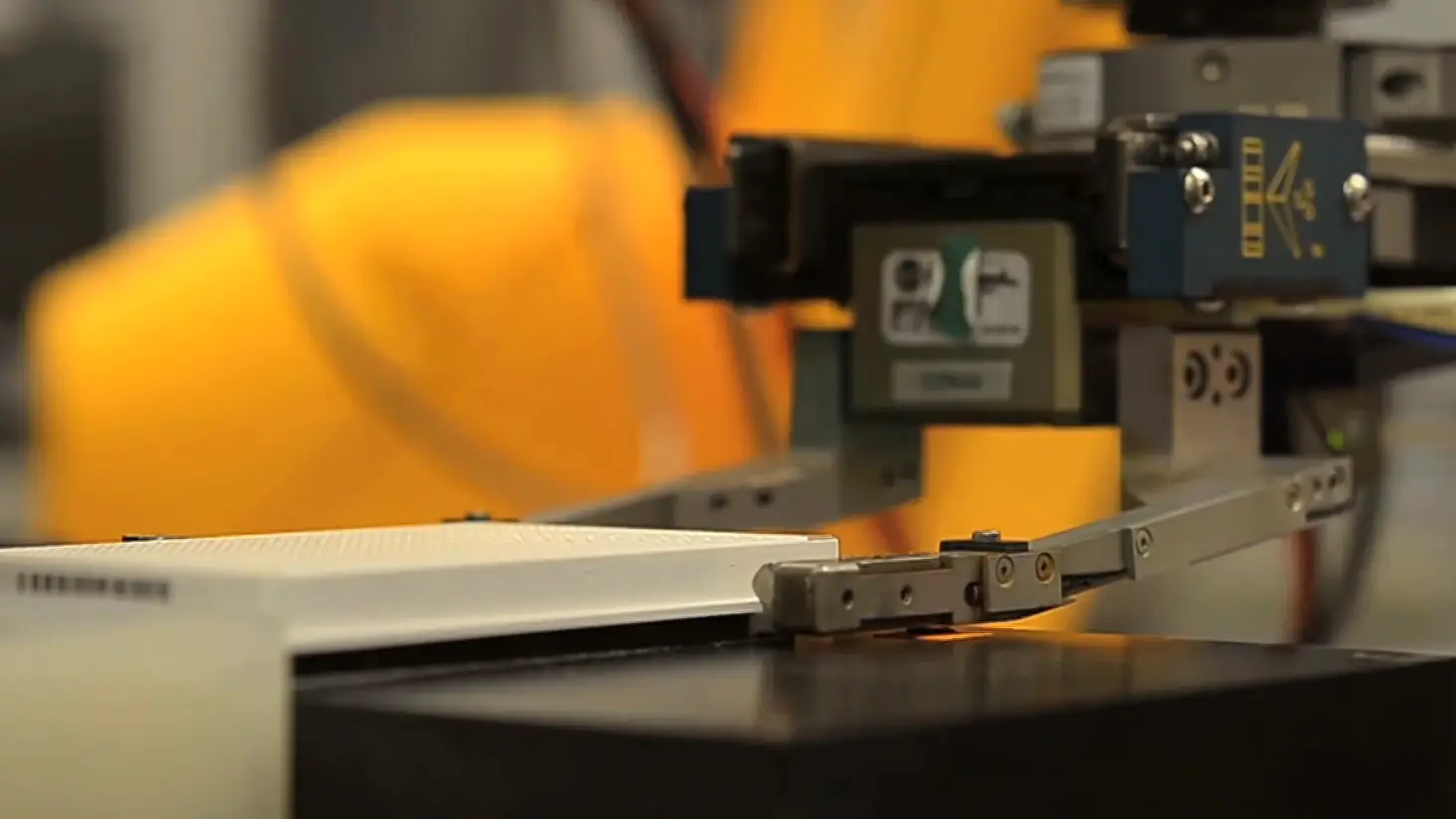
The Allen Institute for AI released RoboTrack on November 23, a benchmark and training set for point tracking in robotic manipulation, and the headline finding is a gap: every leading tracker it evaluated scores 3.0 to 6.6 Average Jaccard points lower on real manipulation footage than on RoboTAP, the robotics benchmark the field has been reporting. The strongest off-the-shelf model, CoWTracker, drops from 70.5 AJ on RoboTAP to 63.9 on RoboTrack-Bench.
Point tracking is the quiet infrastructure of modern manipulation. Given a pixel in one frame, a tracker estimates where that same physical point is in every later frame, whether it is visible, and where it reappears after being hidden. Those trajectories are used to annotate demonstration videos automatically, to guide motion at run time, and as a compact representation of how objects respond to a robot’s actions.
What RoboTrack contains
RoboTrack-Bench is 307 videos with 2,522 human-annotated and human-verified point tracks, drawn from four sources: DROID, Ego-Exo4D, Ai2’s own MolmoAct 2 data and EgoVerse. It deliberately mixes robots and human hands, cluttered scenes, and first- and third-person viewpoints, instead of the controlled tabletop setups that earlier robotics benchmarks favor.
Two annotation choices make it harder than its size suggests. Annotators were told to prioritize points that move or become occluded rather than the many static background points a robot video contains, and each track is labeled as belonging to a robot or human body, a manipulated object or a static object, so failures can be attributed. A second group of annotators checks every track frame by frame. A 33-pair subset is recorded from two synchronized cameras with the same physical points annotated in both views.
The second component is RoboTrack-15M: 3,000 simulated videos from 300 simulated homes, 5,000 tracks each, for 15 million tracks in total. It is generated by extending MolmoSpaces, Ai2’s robot-learning simulator, so point positions and visibility come from the simulator’s own geometry and camera parameters rather than human labels.
Why existing benchmarks were flattering
The evaluation covers CoTracker3, BootsTAPNext, AllTracker and CoWTracker on five benchmarks. Three patterns stand out.
First, scores drop across architectures, which points at the data rather than any one model. Second, rankings reshuffle: CoWTracker’s 4.7 AJ lead over CoTracker3 on RoboTAP shrinks to 2.1 on RoboTrack-Bench, and BootsTAPNext — the strongest model on the general-video DAVIS benchmark — falls 3.7 AJ behind CoWTracker and even trails a Kubric-only AllTracker (60.2 versus 61.4 AJ) despite extra training on 15 million real videos.
Third, the simulated RGB-Stacking benchmark actively disagrees with real manipulation video. Training BootsTAPNext further on real data raises its RoboTrack-Bench score by 5.1 AJ but lowers RGB-Stacking by 9.5 AJ. A benchmark built from simulated block stacking was, in effect, rewarding synthetic-looking inputs.
What the simulated data fixed, and how they found out
Ai2’s first version of the synthetic data produced no gain at all. The diagnosis was a distribution mismatch measured directly: they plotted how far tracked points move in each version of the training data and compared it with RoboTrack-Bench using Jensen-Shannon divergence.
The first version sampled points anywhere in frame — walls, floors, furniture — so from a fixed third-person camera most points never moved. Sampling only on the robot and the handled objects brought the wrist view in line with real video. Moving points off the robot’s fixed base and mounting platform onto the moving arm fixed the third-person view too, lifting the ablation to 63.0 AJ, 1.5 points above the Kubric-only control.
The two released models follow from that: RoboTracker fine-tunes AllTracker (17M parameters) and RoboTracker-Warp fine-tunes CoWTracker (about 1B parameters), each on RoboTrack-15M plus its original data. RoboTracker gains 0.8 AJ on RoboTrack-Bench (62.6 to 63.4) and RoboTracker-Warp 2.1 AJ (63.9 to 66.0), with general-video scores unchanged. RoboTracker-Warp leads on four of the five benchmarks evaluated; its weights are released for noncommercial use.
The wet-lab test that gives the numbers meaning
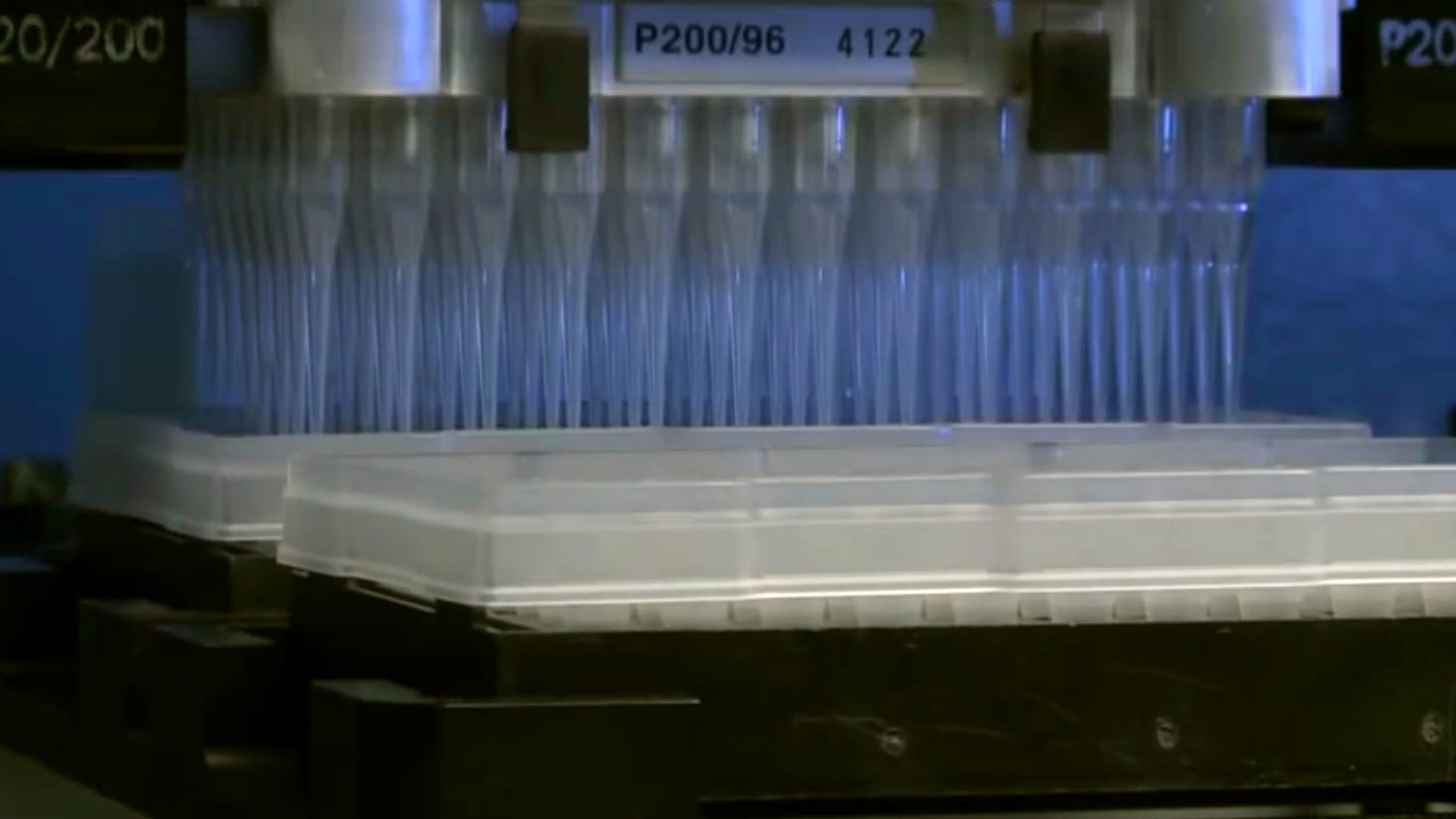
Benchmarks aside, Ai2 put the tracker on a real arm doing a pipetting task: pick up an electronic pipette, draw liquid from one vial, dispense into another, return the pipette. The robot learns from a single teleoperated demonstration and, at test time, compares its camera view with the demonstration to estimate how far the vial has moved — with no feedback during the motion, so the estimate has to be right.
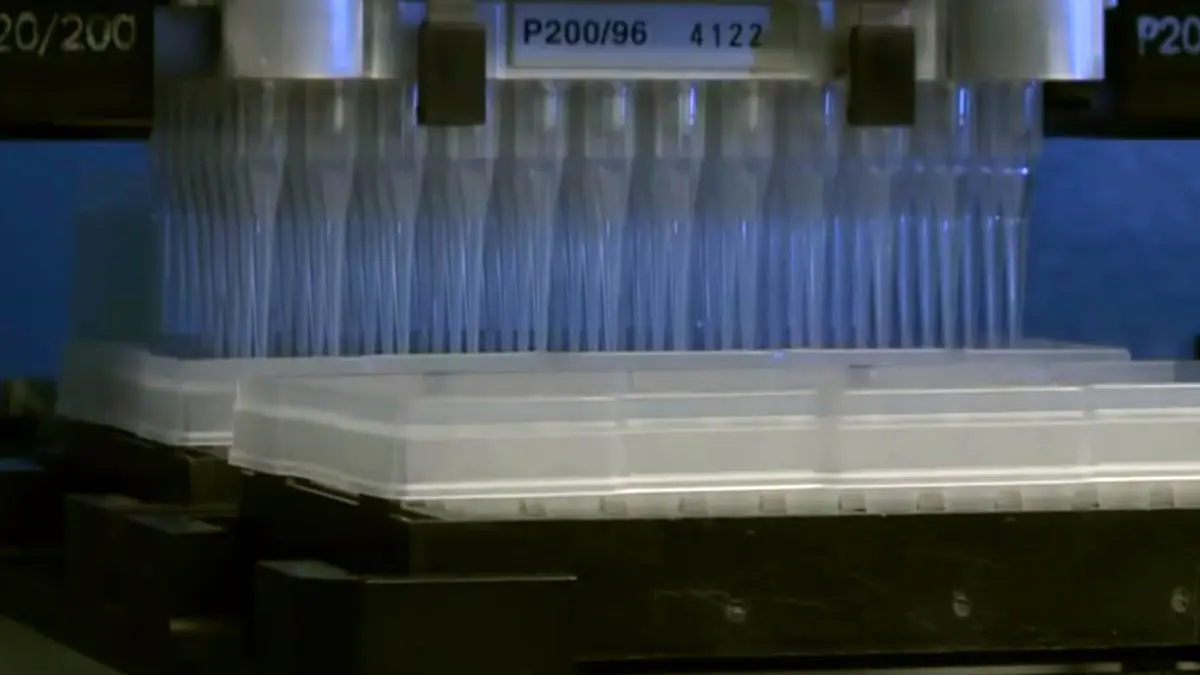
Across 20 vial layouts, 10 clear and 10 partially occluded, point tracking with RoboTracker completed the full transfer 17 times. Object masks from SAM3 managed 8, and optical flow with RAFT managed 5. Under occlusion the mask method succeeded once in ten; point tracking managed seven. The failure modes are instructive: optical flow breaks when the vial is far from its demonstrated position, and masks latch onto a similar object or lose the vial entirely, while tracked points stay attached to the thing being moved.
That is the same class of millimeter-accurate lab task other groups are automating with agents, including Google Research’s closed-loop wet-lab experiments.
What to watch next
- Whether tracker authors report RoboTrack-Bench alongside RoboTAP in new releases.
- Whether simulating precision tasks such as pipetting — not just picking up cups and plates — improves tracking at deployment.
- Progress on the remaining failures: long occlusions, re-finding points that reappear, and small objects on busy backgrounds.
- Use of the 33 synchronized two-camera pairs for multi-view correspondence work.
- Whether policies trained on RoboTrack-15M tracks, rather than just trackers, show gains.
Key takeaways
- RoboTrack-Bench is 307 real manipulation videos with 2,522 verified point tracks across robots, human hands and two viewpoint types.
- Leading trackers score 3.0 to 6.6 AJ lower on it than on RoboTAP, and their relative rankings change.
- RGB-Stacking, a simulated benchmark, can move in the opposite direction to real manipulation video.
- Fine-tuning on the 15M-track simulated set adds up to 2.1 AJ, after the data’s point-motion distribution was matched to real video.
- In a single-demonstration pipetting task, point tracking completed 17 of 20 trials against 8 for masks and 5 for optical flow.
Frequently asked questions
What is point tracking in robotics?
It is following a specific physical point across the frames of a video: where it is, whether it is currently hidden, and where it reappears. Robots use those trajectories to learn from demonstrations and to guide motion during a task.
What does Average Jaccard measure?
Average Jaccard, or AJ, combines how accurately a tracker places points with how well it predicts whether each point is visible. Higher is better, and the metric penalizes a model that keeps guessing positions for points that are occluded.
Are the RoboTrack models and data available?
Yes. Ai2 released the RoboTrack-Bench benchmark, the RoboTrack-15M training set and two models, RoboTracker and RoboTracker-Warp, on Hugging Face. RoboTracker-Warp’s weights are for noncommercial use.